示例2:Müller-Brown 势能
我们测试由Müller-Brown势函数给出的示例:
\[\begin{aligned} E_{MB}(x,y)=\sum_{i=1}^{4}A_{i}\exp [a_{i}(x-\bar{x}_{i})^{2}+b_{i}(x-\bar{x}_{i})(y-\bar{y}_{i})+c_{i}(y-\bar{y}_{i})^{2}]. \end{aligned}\]我们将参数设置为:
\[\begin{aligned} A &= [-200,-100,-170,15], \\ a &= [-1,-1,-6.5,0.7], b=[0,0,11,0.6], c=[-10,-10,-6.5,0.7], \\ \bar{x} &= [1,0,-0.5,-1], \bar{y}=[0,0.5,1.5,1]. \end{aligned}\]首先,我们将 saddlescape-1.0 目录的路径添加到系统路径中:
import sys
import os

sys.path.append(os.path.abspath(os.path.join(os.getcwd(), '..', 'saddlescape-1.0')))
接着,我们导入主类:
from saddlescape import Landscape
import numpy as np

# import packages needed
定义能量函数:
MBP_energyfunc='-200*exp(-1*(x1-1)**2-10*(x2-0)**2)-100*exp(-1*(x1-0)**2-10*(x2-0.5)**2)-170*exp(-6.5*(x1+0.5)**2' \
'+11*(x1+0.5)*(x2-1.5)-6.5*(x2-1.5)**2)+15*exp(0.7*(x1+1)**2+0.6*(x1+1)*(x2-1)+0.7*(x2-1)**2)'
初始化求解器并运行它:
# parameter initialization
x0 = np.array([0.15, 0.25]) # initial point
dt = 4e-4 # time step
k = 1 # the maximum index of saddle point
acceme = 'none' # use the heavy ball to accelerate
maxiter = 5000 # max iter
作为用户自定义时间离散化的一个例子,我们对 $x$ 方程应用二阶显式Adams更新,同时保留默认的特征空间更新。
def adams_bashforth_2nd_for_x(instance, xlist, vlist, glist, dt, j):
    x_n = copy.deepcopy(xlist[-1])
    g_n = copy.deepcopy(glist[-1])
    if vlist is not None:
      # ================== index-k (k>=1) ==================
        v_n = copy.deepcopy(vlist[-1])
        phi_n = g_n - 2.0 * np.matmul(v_n, np.matmul(v_n.T, g_n))
        if j == 1 or len(glist) < 2:
            dx = dt * phi_n
        else:
            v_prev = copy.deepcopy(vlist[-2])
            g_prev = copy.deepcopy(glist[-2])
            phi_prev = g_prev - 2.0 * np.matmul(v_prev, np.matmul(v_prev.T, g_prev))
            dx = dt * (1.5 * phi_n - 0.5 * phi_prev)
        x_next = x_n - dx
        v_next, whetherkindex = instance.EigVecMethod(x_next, v_n)
        return x_next, v_next, whetherkindex
    else:
        # ================== index-0 ==================
        if j == 1 or len(glist) < 2:
            dx = dt * g_n
        else:
            # Second-order explicit Adams-Bashforth scheme for x
            g_prev = glist[-2]
            dx = dt * (1.5 * g_n - 0.5 * g_prev)
        x_next = x_n - dx
        return x_next
由于能量函数比较陡峭,所以用历史梯度的多步法反而会导致较大误差,降低搜索效率,此处只是为了展示如何使用自定义格式。但二者最终的搜索轨迹和景观基本一致,此处仅展示用户自定义版本的结果。(详细结果:默认格式结果Ex_2_MullerBrownPotential,用户自定义格式结果Ex_2_MullerBrownPotential-Adams2nd.ipynb)
MyLandscape = Landscape(MaxIndex=k, AutoDiff=True, ExactHessian=True, EnergyFunction=MBP_energyfunc,
                        InitialPoint=x0, TimeStep=dt, Acceleration=acceme,
                        EigenStepSize=1e-7, MaxIter=maxiter,EigenMethod='euler', Verbose=True, ReportInterval=100)
# Instantiation
MyLandscape.Run()
# Calculate
HiSD Solver Configuration:
------------------------------
[HiSD] Current parameters (initialized):
[Config Sync] `Dim` parameter auto-adjusted to 2 based on `InitialPoint` dimensionality.
Parameter `NumericalGrad` not specified - using default value False.
Parameter `Momentum` not specified - using default value 0.0.
Parameter `DimerLength` not specified - using default value 1e-05.
Parameter `Tolerance` not specified - using default value 1e-06.
Parameter `NesterovChoice` not specified - using default value 1.
Parameter `SearchArea` not specified - using default value 1000.0.
Parameter `NesterovRestart` not specified - using default value None.
Parameter `EigenMaxIter` not specified - using default value 10.
Parameter `HessianDimerLength` not specified - using default value 1e-05.
Parameter `PrecisionTol` not specified - using default value 1e-05.
Parameter `EigvecUnified` not specified - using default value False.
Parameter 'GradientSystem' not provided. Enabling automatic symmetry detection.
Parameter 'SymmetryCheck' not provided. Defaulting to True with automatic detection if available.


Gradient system detected. Activating HiSD algorithm.


Landscape Configuration:
------------------------------
[Landscape] Current parameters (initialized):
Parameter `SameJudgementMethod` not specified - using default value <function LandscapeCheckParam.<locals>.<lambda> at 0x0000026E5D1DD480>.
Parameter `PerturbationMethod` not specified - using default value uniform.
Parameter `PerturbationRadius` not specified - using default value 0.0001.
Parameter `InitialEigenVectors` not specified - using default value None.
Parameter `PerturbationNumber` not specified - using default value 2.
Parameter `SaveTrajectory` not specified - using default value True.
Parameter `MaxIndexGap` not specified - using default value 1.
Parameter `EigenCombination` not specified - using default value all.

Start running:
------------------------------


From initial point search index-1:
------------------------------


Iteration: 100|| Norm of gradient: 0.244166
Iteration: 200|| Norm of gradient: 0.001484
Iteration: 300|| Norm of gradient: 0.000009
Non-degenerate saddle point identified: Morse index =1 (number of negative eigenvalues).


From saddle point (index-1, ID-0) search index-0:
------------------------------


Iteration: 100|| Norm of gradient: 42.551369
Iteration: 200|| Norm of gradient: 5.900040
Iteration: 300|| Norm of gradient: 0.644674
Iteration: 400|| Norm of gradient: 0.070684
Iteration: 500|| Norm of gradient: 0.007754
Iteration: 600|| Norm of gradient: 0.000851
Iteration: 700|| Norm of gradient: 0.000093
Iteration: 800|| Norm of gradient: 0.000010
Iteration: 900|| Norm of gradient: 0.000001
Non-degenerate saddle point identified: Morse index =0 (number of negative eigenvalues).


From saddle point (index-1, ID-0) search index-0:
------------------------------


Iteration: 100|| Norm of gradient: 112.301955
Iteration: 200|| Norm of gradient: 1.454184
Iteration: 300|| Norm of gradient: 0.006413
Iteration: 400|| Norm of gradient: 0.000028
Non-degenerate saddle point identified: Morse index =0 (number of negative eigenvalues).


From saddle point (index-1, ID-0) search index-0:
------------------------------


Iteration: 100|| Norm of gradient: 112.301955
Iteration: 200|| Norm of gradient: 1.454184
Iteration: 300|| Norm of gradient: 0.006413
Iteration: 400|| Norm of gradient: 0.000028
Non-degenerate saddle point identified: Morse index =0 (number of negative eigenvalues).


From saddle point (index-1, ID-0) search index-0:
------------------------------


Iteration: 100|| Norm of gradient: 42.551369
Iteration: 200|| Norm of gradient: 5.900040
Iteration: 300|| Norm of gradient: 0.644674
Iteration: 400|| Norm of gradient: 0.070684
Iteration: 500|| Norm of gradient: 0.007754
Iteration: 600|| Norm of gradient: 0.000851
Iteration: 700|| Norm of gradient: 0.000093
Iteration: 800|| Norm of gradient: 0.000010
Iteration: 900|| Norm of gradient: 0.000001
Non-degenerate saddle point identified: Morse index =0 (number of negative eigenvalues).
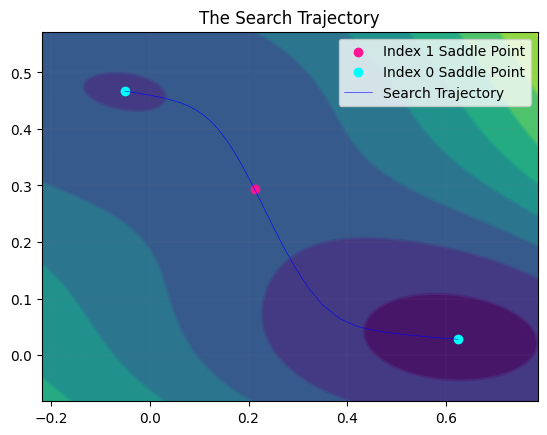
我们可以绘制搜索轨迹。
MyLandscape.DrawTrajectory(ContourGridNum=100, ContourGridOut=25, DetailedTraj=True)
# Draw the search path. But because of the large dimension, we cannot draw the picture.
我们也可以绘制解景观。
MyLandscape.DrawConnection()
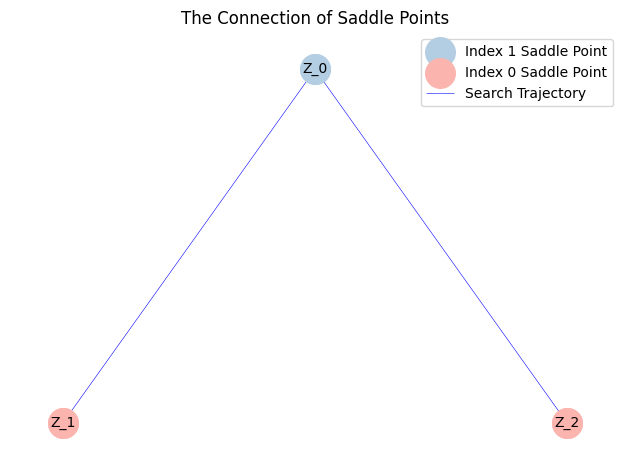
然而,Müller-Brown势描述了一个具有多峰分布的典型系统。因此,上面展示的解景观并不完整。于是,我们从局部最小值重新开始搜索:
MyLandscape.RestartFromSaddle(1,-np.array([[-0.01],[0]]),1)
# Calculate
From initial point search index-1:
------------------------------


Iteration: 100|| Norm of gradient: 19.312756
Iteration: 200|| Norm of gradient: 73.350020
Iteration: 300|| Norm of gradient: 5.393141
Iteration: 400|| Norm of gradient: 0.296593
Iteration: 500|| Norm of gradient: 0.007024
Iteration: 600|| Norm of gradient: 0.000128
Iteration: 700|| Norm of gradient: 0.000001
Non-degenerate saddle point identified: Morse index =1 (number of negative eigenvalues).


From saddle point (index-1, ID-3) search index-0:
------------------------------


Iteration: 100|| Norm of gradient: 173.689102
Iteration: 200|| Norm of gradient: 11.176428
Iteration: 300|| Norm of gradient: 0.189779
Iteration: 400|| Norm of gradient: 0.003139
Iteration: 500|| Norm of gradient: 0.000052
Non-degenerate saddle point identified: Morse index =0 (number of negative eigenvalues).


From saddle point (index-1, ID-3) search index-0:
------------------------------


Iteration: 100|| Norm of gradient: 59.383010
Iteration: 200|| Norm of gradient: 25.552611
Iteration: 300|| Norm of gradient: 2.958465
Iteration: 400|| Norm of gradient: 0.325632
Iteration: 500|| Norm of gradient: 0.035736
Iteration: 600|| Norm of gradient: 0.003921
Iteration: 700|| Norm of gradient: 0.000430
Iteration: 800|| Norm of gradient: 0.000047
Iteration: 900|| Norm of gradient: 0.000005
Non-degenerate saddle point identified: Morse index =0 (number of negative eigenvalues).


From saddle point (index-1, ID-3) search index-0:
------------------------------


Iteration: 100|| Norm of gradient: 59.383010
Iteration: 200|| Norm of gradient: 25.552611
Iteration: 300|| Norm of gradient: 2.958465
Iteration: 400|| Norm of gradient: 0.325632
Iteration: 500|| Norm of gradient: 0.035736
Iteration: 600|| Norm of gradient: 0.003921
Iteration: 700|| Norm of gradient: 0.000430
Iteration: 800|| Norm of gradient: 0.000047
Iteration: 900|| Norm of gradient: 0.000005
Non-degenerate saddle point identified: Morse index =0 (number of negative eigenvalues).


From saddle point (index-1, ID-3) search index-0:
------------------------------


Iteration: 100|| Norm of gradient: 173.689102
Iteration: 200|| Norm of gradient: 11.176428
Iteration: 300|| Norm of gradient: 0.189779
Iteration: 400|| Norm of gradient: 0.003139
Iteration: 500|| Norm of gradient: 0.000052
Non-degenerate saddle point identified: Morse index =0 (number of negative eigenvalues).
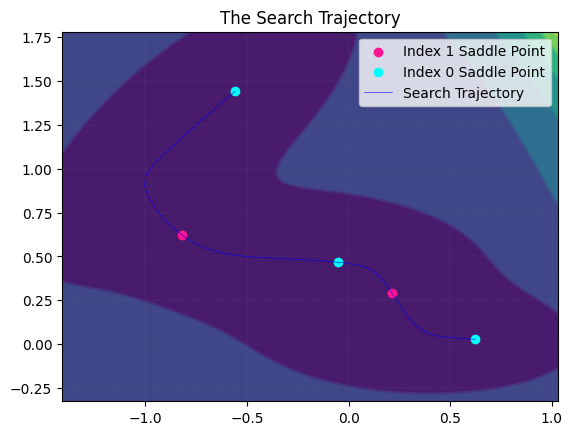
MyLandscape.DrawTrajectory(ContourGridNum=100, ContourGridOut=25, DetailedTraj=True)
# Draw the search path. But because of the large dimension, we cannot draw the picture.
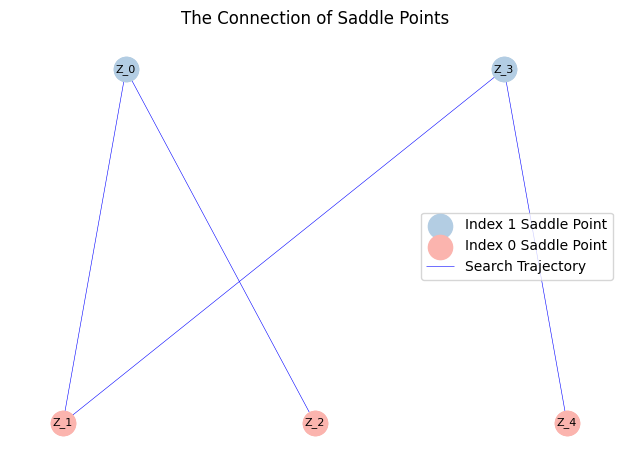
从输出结果中,我们可以得到一个完整的解景观。
MyLandscape.DrawConnection()
MyLandscape.Save('output/Ex_MBP','pickle')
# Save the data