Example 2 : Müller-Brown Potential
We test the Müller-Brown potential given by
\[\begin{aligned} E_{MB}(x,y)=\sum_{i=1}^{4}A_{i}\exp [a_{i}(x-\bar{x}_{i})^{2}+b_{i}(x-\bar{x}_{i})(y-\bar{y}_{i})+c_{i}(y-\bar{y}_{i})^{2}]. \end{aligned}\]We set the parameters as
\[\begin{aligned} A &= [-200,-100,-170,15], \\ a &= [-1,-1,-6.5,0.7], b=[0,0,11,0.6], c=[-10,-10,-6.5,0.7], \\ \bar{x} &= [1,0,-0.5,-1], \bar{y}=[0,0.5,1.5,1]. \end{aligned}\]First, we add the path of the saddlescape-1.0 directory to the system path.
import sys
import os

sys.path.append(os.path.abspath(os.path.join(os.getcwd(), '..', 'saddlescape-1.0')))
Then, we import the main class.
from saddlescape import Landscape
import numpy as np

# import packages needed
We define the energy function.
MBP_energyfunc='-200*exp(-1*(x1-1)**2-10*(x2-0)**2)-100*exp(-1*(x1-0)**2-10*(x2-0.5)**2)-170*exp(-6.5*(x1+0.5)**2' \
'+11*(x1+0.5)*(x2-1.5)-6.5*(x2-1.5)**2)+15*exp(0.7*(x1+1)**2+0.6*(x1+1)*(x2-1)+0.7*(x2-1)**2)'
We initialize the solver and run it.
# parameter initialization
x0 = np.array([0.15, 0.25]) # initial point
dt = 4e-4 # time step
k = 1 # the maximum index of saddle point
acceme = 'none' # use the heavy ball to accelerate
maxiter = 5000 # max iter
As an example of user-defined temporal discretization, we apply a second-order explicit Adams update to the $x$-equation while retaining the default eigenspace update.
def adams_bashforth_2nd_for_x(instance, xlist, vlist, glist, dt, j):
    x_n = copy.deepcopy(xlist[-1])
    g_n = copy.deepcopy(glist[-1])
    if vlist is not None:
      # ================== index-k (k>=1) ==================
        v_n = copy.deepcopy(vlist[-1])
        phi_n = g_n - 2.0 * np.matmul(v_n, np.matmul(v_n.T, g_n))
        if j == 1 or len(glist) < 2:
            dx = dt * phi_n
        else:
            v_prev = copy.deepcopy(vlist[-2])
            g_prev = copy.deepcopy(glist[-2])
            phi_prev = g_prev - 2.0 * np.matmul(v_prev, np.matmul(v_prev.T, g_prev))
            dx = dt * (1.5 * phi_n - 0.5 * phi_prev)
        x_next = x_n - dx
        v_next, whetherkindex = instance.EigVecMethod(x_next, v_n)
        return x_next, v_next, whetherkindex
    else:
        # ================== index-0 ==================
        if j == 1 or len(glist) < 2:
            dx = dt * g_n
        else:
            # Second-order explicit Adams-Bashforth scheme for x
            g_prev = glist[-2]
            dx = dt * (1.5 * g_n - 0.5 * g_prev)
        x_next = x_n - dx
        return x_next
Due to the steepness of the energy function, using multi-step methods based on historical gradients may introduce larger errors and reduce search efficiency. This example is solely intended to demonstrate how to use a custom scheme. Nevertheless, the final search trajectories and landscapes obtained by both methods are essentially identical. Here we present only the results from the user-defined version. (Detailed results: default scheme result Ex_2_MullerBrownPotential; user-defined scheme result Ex_2_MullerBrownPotential-Adams2nd.ipynb)
MyLandscape = Landscape(MaxIndex=k, AutoDiff=True, ExactHessian=True, EnergyFunction=MBP_energyfunc,
                        InitialPoint=x0, TimeStep=dt, Acceleration=acceme,
                        EigenStepSize=1e-7, MaxIter=maxiter,EigenMethod='euler', Verbose=True, ReportInterval=100)
# Instantiation
MyLandscape.Run()
# Calculate
HiSD Solver Configuration:
------------------------------
[HiSD] Current parameters (initialized):
[Config Sync] `Dim` parameter auto-adjusted to 2 based on `InitialPoint` dimensionality.
Parameter `NumericalGrad` not specified - using default value False.
Parameter `Momentum` not specified - using default value 0.0.
Parameter `DimerLength` not specified - using default value 1e-05.
Parameter `Tolerance` not specified - using default value 1e-06.
Parameter `NesterovChoice` not specified - using default value 1.
Parameter `SearchArea` not specified - using default value 1000.0.
Parameter `NesterovRestart` not specified - using default value None.
Parameter `EigenMaxIter` not specified - using default value 10.
Parameter `HessianDimerLength` not specified - using default value 1e-05.
Parameter `PrecisionTol` not specified - using default value 1e-05.
Parameter `EigvecUnified` not specified - using default value False.
Parameter 'GradientSystem' not provided. Enabling automatic symmetry detection.
Parameter 'SymmetryCheck' not provided. Defaulting to True with automatic detection if available.


Gradient system detected. Activating HiSD algorithm.


Landscape Configuration:
------------------------------
[Landscape] Current parameters (initialized):
Parameter `SameJudgementMethod` not specified - using default value <function LandscapeCheckParam.<locals>.<lambda> at 0x0000026E5D1DD480>.
Parameter `PerturbationMethod` not specified - using default value uniform.
Parameter `PerturbationRadius` not specified - using default value 0.0001.
Parameter `InitialEigenVectors` not specified - using default value None.
Parameter `PerturbationNumber` not specified - using default value 2.
Parameter `SaveTrajectory` not specified - using default value True.
Parameter `MaxIndexGap` not specified - using default value 1.
Parameter `EigenCombination` not specified - using default value all.

Start running:
------------------------------


From initial point search index-1:
------------------------------


Iteration: 100|| Norm of gradient: 0.244166
Iteration: 200|| Norm of gradient: 0.001484
Iteration: 300|| Norm of gradient: 0.000009
Non-degenerate saddle point identified: Morse index =1 (number of negative eigenvalues).


From saddle point (index-1, ID-0) search index-0:
------------------------------


Iteration: 100|| Norm of gradient: 42.551369
Iteration: 200|| Norm of gradient: 5.900040
Iteration: 300|| Norm of gradient: 0.644674
Iteration: 400|| Norm of gradient: 0.070684
Iteration: 500|| Norm of gradient: 0.007754
Iteration: 600|| Norm of gradient: 0.000851
Iteration: 700|| Norm of gradient: 0.000093
Iteration: 800|| Norm of gradient: 0.000010
Iteration: 900|| Norm of gradient: 0.000001
Non-degenerate saddle point identified: Morse index =0 (number of negative eigenvalues).


From saddle point (index-1, ID-0) search index-0:
------------------------------


Iteration: 100|| Norm of gradient: 112.301955
Iteration: 200|| Norm of gradient: 1.454184
Iteration: 300|| Norm of gradient: 0.006413
Iteration: 400|| Norm of gradient: 0.000028
Non-degenerate saddle point identified: Morse index =0 (number of negative eigenvalues).


From saddle point (index-1, ID-0) search index-0:
------------------------------


Iteration: 100|| Norm of gradient: 112.301955
Iteration: 200|| Norm of gradient: 1.454184
Iteration: 300|| Norm of gradient: 0.006413
Iteration: 400|| Norm of gradient: 0.000028
Non-degenerate saddle point identified: Morse index =0 (number of negative eigenvalues).


From saddle point (index-1, ID-0) search index-0:
------------------------------


Iteration: 100|| Norm of gradient: 42.551369
Iteration: 200|| Norm of gradient: 5.900040
Iteration: 300|| Norm of gradient: 0.644674
Iteration: 400|| Norm of gradient: 0.070684
Iteration: 500|| Norm of gradient: 0.007754
Iteration: 600|| Norm of gradient: 0.000851
Iteration: 700|| Norm of gradient: 0.000093
Iteration: 800|| Norm of gradient: 0.000010
Iteration: 900|| Norm of gradient: 0.000001
Non-degenerate saddle point identified: Morse index =0 (number of negative eigenvalues).
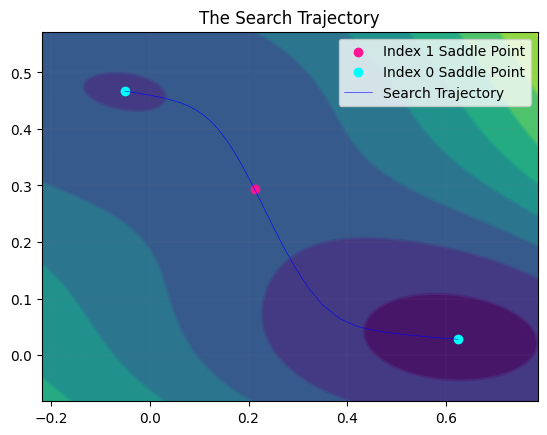
We draw the search trajectory.
MyLandscape.DrawTrajectory(ContourGridNum=100, ContourGridOut=25, DetailedTraj=True)
# Draw the search path. But because of the large dimension, we cannot draw the picture.
We can also draw the solution landscape.
MyLandscape.DrawConnection()
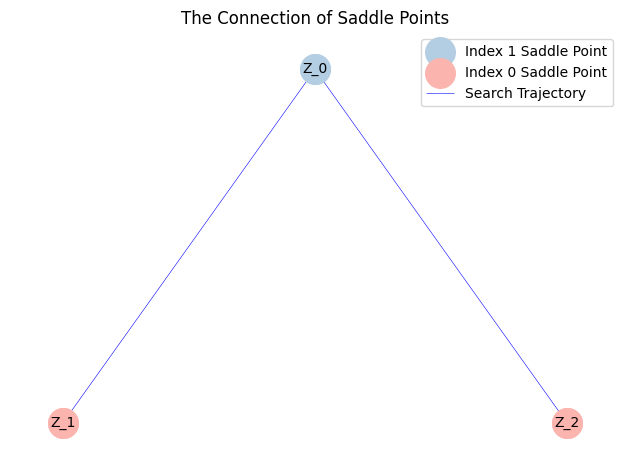
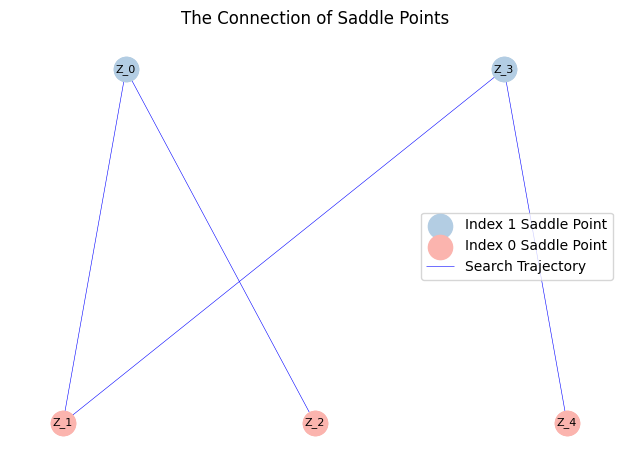
However, the Müller-Brown Potential describes a typical system with a multimodal distribution. The solution landscape shown above is therefore incomplete. Then, we restarted the search from a local minimum:
MyLandscape.RestartFromSaddle(1,np.array([[-0.01],[0]]),1)
# Calculate
From initial point search index-1:
------------------------------


Iteration: 100|| Norm of gradient: 19.312756
Iteration: 200|| Norm of gradient: 73.350020
Iteration: 300|| Norm of gradient: 5.393141
Iteration: 400|| Norm of gradient: 0.296593
Iteration: 500|| Norm of gradient: 0.007024
Iteration: 600|| Norm of gradient: 0.000128
Iteration: 700|| Norm of gradient: 0.000001
Non-degenerate saddle point identified: Morse index =1 (number of negative eigenvalues).


From saddle point (index-1, ID-3) search index-0:
------------------------------


Iteration: 100|| Norm of gradient: 173.689102
Iteration: 200|| Norm of gradient: 11.176428
Iteration: 300|| Norm of gradient: 0.189779
Iteration: 400|| Norm of gradient: 0.003139
Iteration: 500|| Norm of gradient: 0.000052
Non-degenerate saddle point identified: Morse index =0 (number of negative eigenvalues).


From saddle point (index-1, ID-3) search index-0:
------------------------------


Iteration: 100|| Norm of gradient: 59.383010
Iteration: 200|| Norm of gradient: 25.552611
Iteration: 300|| Norm of gradient: 2.958465
Iteration: 400|| Norm of gradient: 0.325632
Iteration: 500|| Norm of gradient: 0.035736
Iteration: 600|| Norm of gradient: 0.003921
Iteration: 700|| Norm of gradient: 0.000430
Iteration: 800|| Norm of gradient: 0.000047
Iteration: 900|| Norm of gradient: 0.000005
Non-degenerate saddle point identified: Morse index =0 (number of negative eigenvalues).


From saddle point (index-1, ID-3) search index-0:
------------------------------


Iteration: 100|| Norm of gradient: 59.383010
Iteration: 200|| Norm of gradient: 25.552611
Iteration: 300|| Norm of gradient: 2.958465
Iteration: 400|| Norm of gradient: 0.325632
Iteration: 500|| Norm of gradient: 0.035736
Iteration: 600|| Norm of gradient: 0.003921
Iteration: 700|| Norm of gradient: 0.000430
Iteration: 800|| Norm of gradient: 0.000047
Iteration: 900|| Norm of gradient: 0.000005
Non-degenerate saddle point identified: Morse index =0 (number of negative eigenvalues).


From saddle point (index-1, ID-3) search index-0:
------------------------------


Iteration: 100|| Norm of gradient: 173.689102
Iteration: 200|| Norm of gradient: 11.176428
Iteration: 300|| Norm of gradient: 0.189779
Iteration: 400|| Norm of gradient: 0.003139
Iteration: 500|| Norm of gradient: 0.000052
Non-degenerate saddle point identified: Morse index =0 (number of negative eigenvalues).
MyLandscape.DrawTrajectory(ContourGridNum=100, ContourGridOut=25, DetailedTraj=True)
# Draw the search path. But because of the large dimension, we cannot draw the picture.
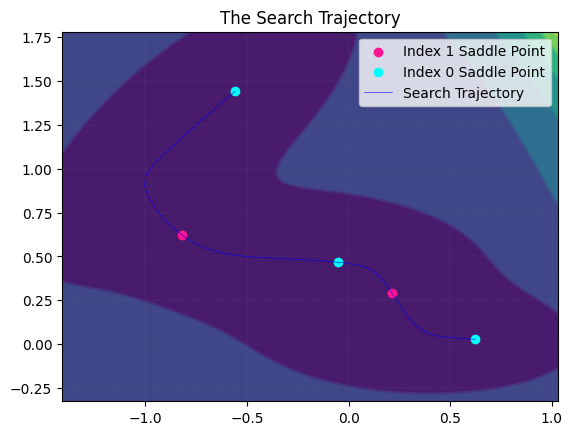
From the output, we can find a complete solution landscape.
MyLandscape.DrawConnection()
MyLandscape.Save('output/Ex_MBP','pickle')
# Save the data